
It is doubtful that our political masters are even aware of the features of the Model Law.

The broader NSE Nifty too slipped by 9.50 points, or 0.09 per cent, to end at 10,118.25
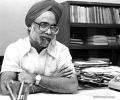
What stood out in his 15-year journey as a member of the political executive at the Centre was his glowing record as India's most successful and effective finance minister. Both as prime minister and finance minister, he understood the importance of gradualism, except when the economy or the polity was in a crisis.

There hasn't been any dramatic moment in the first act (the Budget) but nobody would complain. It's par for the course as long as the figures don't change in the main Budget, which will be presented after general elections.

Aerated drinks, mineral water, travel packages, coaching classes and beauty parlour services might also cost more
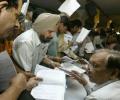
Continued lack of consensus at next meeting could cast shadow on GST rollout by April 1.
Ask rediffGURU and PF and MF expert Janak Patel your mutual fund and personal finance-related questions.

GST would make compliance easier for big businesses, but hurt small scale industries., says SJM

Top Congress leaders from Karnataka led by Chief Minister Siddaramaiah on Wednesday held a protest in Delhi against the Centre over alleged injustice to the southern state in devolution of taxes, sparking a fierce slugfest between the party and the Modi government.
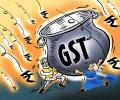
With most states on board to raise revenue so that they do not have to depend on Centre for compensation, the GST Council at its meeting next month is likely to consider a proposal to do away with the 5 per cent slab by moving some goods of mass consumption to 3 per cent and the remaining to 8 per cent categories, sources said. Currently, GST is a four-tier structure of 5, 12, 18 and 28 per cent. Besides, gold and gold jewellery attract 3 per cent tax. In addition, there is an exempt list of items like unbranded and unpacked food items which do not attract the levy.

GST will make it easier for governments to spend more, says T C A Srinivasa Raghavan.

Amid record-high fuel prices, Finance Minister Nirmala Sitharaman on Monday said there is no proposal as of now to bring crude oil, petrol, diesel, jet fuel (ATF) and natural gas under the Goods and Services Tax (GST). When the GST was introduced on July 1, 2017, amalgamating over a dozen central and state levies, five commodities - crude oil, natural gas, petrol, diesel, and aviation turbine fuel (ATF) - were kept out of its purview given the revenue dependence of the central and state governments on this sector. This meant that the central government continued to levy excise duty on them while state governments charged VAT. These taxes, with excise duty, in particular, have been raised periodically.

'If petro products are brought into GST, then there will be minor impact on the incidence of tax... and minor impact on prices. The price of petrol, diesel will continue to be driven by global factors'

According to the NIPFP, there is the possibility that even if the banking system matures over time, some transactions could bypass the system so as not to pay the BTT.
The Goods and Services Tax (GST) Council, which is likely to meet in the third or fourth week of June, is set to clear the operational framework of the much-awaited GST appellate tribunal, which will deal with tax disputes and streamline resolution. "The final blueprint, mainly the operational part, is expected to be presented in the GST Council meeting for approval. "This will pave the way for the tribunal to be functional, both at the central and state levels," said a senior government official, who expects the tribunal to be up and running by November.

Plug-in hybrids have two engines and the electric part has a much larger battery than in the regular hybrids. Car companies, led by the Japanese, are pushing the Indian government to look at hybrids in the interim if it wants to reduce carbon emission.

An audit conducted by professional services firm Alvarez and Marsal confirms fintech firm's dealings with fake or non-existent vendors.

'I found it unbelievable that L&T said 45,000 jobs were waiting to be filled because of unavailability of suitable skillsets.' 'So, when the Opposition sweepingly says there are no jobs, I'm sorry... I'm not saying it's raining jobs, but there are jobs. The (skill) gap has to be bridged.'

The bill was passed by LS last year and now it has to go back to the Lower House for incorporating the amendments approved by Rajya Sabha.

The United Kingdom extracted USD 64.82 trillion from India over a century of colonialism between 1765 and 1900 and USD 33.8 trillion of this went to the richest 10 per cent -- enough money to carpet London in notes of 50 British pound almost four times over.

The richest one per cent in India now own more than 40 per cent of the country's total wealth, while the bottom half of the population together share just 3 per cent of wealth, a new study showed on Monday.
The June quarter is usually considered as a seasonally strong period for the IT sector.
The GST Council might on Friday consider taxing petrol, diesel and other petroleum products under the single national GST regime, a move that may require huge compromises by both central and state governments on the revenues they collect from taxing these products. The Council, which comprises central and state finance ministers, in its meeting scheduled in Lucknow on Friday, is also likely to consider extending the time for duty relief on COVID-19 essentials, according to sources in the know of the development. GST is being thought to be a solution for the problem of near-record high petrol and diesel rates in the country, as it would end the cascading effect of tax on tax (state VAT being levied not just on the cost of production but also on the excise duty charged by the Centre on such output).

The Appellate Authority for Advance Rulings (AAAR) of Gujarat has held that papad fryums would not attract any goods and services tax (GST) as they are similar to traditional round papads in all respects. In this connection, the appellate authority modified the ruling of the authority for advance rulings (AAR), which had ruled that Fryums would attract 18 per cent GST. The AAAR held that Fryums is a brand and not a generic name of the product, Harpreet Singh, partner, indirect taxes at KPMG in India said while explaining the order.

In September, JSW MG Motor India, the newly minted joint venture between SAIC Motor, which is present in 100 countries, and Indian conglomerate JSW Group, launched the Windsor, an electric car that introduced battery as a service (BaaS).

When it comes to electric cars, the electric dream is turning out to be a six-letter word starting with f, ending with y, and having antas in between, notes Suveen Sinha.
The Securities and Exchange Board of India (Sebi) might relax the disclosure norms around rumour verification to help smooth implementation and ease compliance amid pushback from India Inc, said people in the know. The rule has been notified following amendments to the Listing Obligations and Disclosure Requirements (LODR) by Sebi. However, its implementation has been deferred until February.

Deadline ends, after two extensions and only 70% file detailed return for July

New ITR forms indirectly force small businesses to maintain books of accounts, something that wasn't needed earlier, says Anupam Jain.

The National Testing Agency announced that the JEE (Main) will be held from September 1 to 6 and NEET (UG) on September 13 after the Supreme Court dismissed a petition seeking the postponement of the NEET and JEE.

The richest one per cent in India now own more than 40 per cent of the country's total wealth, while the bottom half of the population together share just 3 per cent of wealth, a new study showed on Monday. Releasing the India supplement of its annual inequality report on the first day of the World Economic Forum Annual Meeting in Davos, rights group Oxfam International said that taxing India's ten-richest at 5 per cent can fetch entire money to bring children back to school. "A one-off tax on unrealized gains from 2017-2021 on just one billionaire, Gautam Adani, could have raised Rs 1.79 lakh crore, enough to employ more than five million Indian primary school teachers for a year," it added.

Government-controlled oil-marketing companies (OMCs) have held back petrol and diesel price revisions for a week and are expected to continue doing so, ostensibly owing to political reasons. It appears that the Centre has informally conveyed to the three major OMCs to not revise fuel prices for the time being, two people in the government said. This informal directive follows the talks between the Centre and states on cutting taxes and bringing the auto fuels under the good service tax regime not fetching the desired results, so far.

'China is struggling to get out of its property bubble.' 'Japan took 35 years to walk out of its equity bubble.' 'Bubbles can be difficult to forecast.'

The stock of the country's largest passenger vehicle maker, Maruti Suzuki India (MSIL), has been hitting successive all-time highs over the past three trading sessions. The rally in the scrip has helped it notch over a 21 per cent gain since the start of February, outperforming the National Stock Exchange Nifty Auto Index. The gains for the leader of small passenger cars have been more recent, as the company still trails the Nifty Auto over one- and two-year periods.

What is most troubling is that not a single party that is part of INDIA has talked about any kind of reform and economic sense, argues R Jagannathan.

The implementation of the GST will indeed be a landmark reform.

If the new regime is introduced in 2017, the govt may lose out on cess, surcharge

Assocham president Niranjan Hiranandani said his talks with government officials showed dues to industry and states were pending in the form of refunds of income tax, value-added tax, and GST, and compensation, payments to discoms in the power sector, fertiliser subsidies, etc.

The Securities and Exchange Board of India (Sebi) is considering a proposal to allow mutual funds (MFs) to charge a fee based on their performance, said Ananta Barua, whole-time member of the markets regulator. He said the proposal is being reviewed by a working group formed to look into cost structures. "One working group has been set up which is going to review... One of the suggestions is that if any scheme or fund is performing well above the benchmark, it (fee) can be linked to its performance.

'Investors hate uncertainty and the demonetisation move certainly creates that.'
